
Items
Search full-text
Paralympic Arts Festival
-
“The National Disability Strategy 2010–2020 is launched and, later, Australia’s Disability Strategy 2021-2031” The Australian Government launched the National Disability Strategy 2010–2020 in 2011. All levels of government were involved in a united national approach to improving life for people with disabilities, their families and carers. The National Disability Insurance Scheme (NDIS) was an outcome of this process. In 2021, the Disability Strategy Advisory Council was established and the most recent iteration of the strategy, Australia’s Disability Strategy 2021-2031, outlines a vision for a more inclusive and accessible Australian society where all people with disability can fulfil their potential as equal members of the community.
-
“In 2003, a demonstration outside Canberra’s Parliament House protests changes to Centrelink guidelines” In 2003, the Totally and Permanently Incapacitated Disabled Soldiers Association staged a protest outside Parliament House in Canberra, over changes to Centrelink guidelines that could have cost them up to $200 per week in income. “He said in Parliament that our payments are adequate, he's somebody who has never had the time to speak to us,” Association President John Ryan remarked of then Prime Minister John Howard.
-
“Women With Disabilities Australia (WWDA) recognised as an independent organisation in 1995” Women With Disabilities Australia (WWDA) gained seed funding from the government in 1994 and was recognised as an independent organisation in 1995. The organisation shares a history with Disabled People’s International (Australia) (established 1983) and its National Women’s Network (established 1985).
-
“Disabled People’s International (Australia) (DPIA) formed in 1983” The organisation Disabled People’s International (Australia) (DPIA) was formed in 1983. Thirteen disabled Australians who attended Disabled People’s International (DPI) first world assembly in Singapore in 1981, the International Year of the Disabled Person, returned home to set up the Australian branch two years later. The Women with Disabilities Australia online history reports that DPIA “from the outset, was dominated by disabled men. Only 3 of the 11 members of its governance structure were women, and there was no mention of women or gender in DPIA goals and objectives.” This led to the establishment of a women’s network within DPIA, known as the National Women’s Network (DPIA).
-
“Demonstrators protest inadequate funding for disability support in Adelaide, 1992” On the 13th March, 1992, 100 demonstrators gathered in Adelaide to protest inadequate funding for disability support. Deputy Prime Minister and Minister for Health, Housing and Community Services Brian Howe was “heckled” by the group outside an event at Jubilee Hall during a health care expo. Howe agreed later that year to “honour a federal government promise to expand the National Attendant Care Scheme,” that is, after another demonstration by 70 advocates outside Parliament House.
-
“Commonwealth Disability Strategy launched in December 1994” The Commonwealth Disability Strategy was launched in December 1994. The strategy was meant to ensure compliance by Commonwealth Departments with the Disability Discrimination Act (DDA) (passed in 1992). The Museum of Australian Democracy at Old Parliament House reports that “Results have been uneven, especially in employment, but the Act has made some breakthroughs on education and disability access in new buildings.”
-
“Queensland Advocacy Incorporated spearhead campaigns to close institutions” In 1989, when the Bjelke-Petersen-Ahern Government was coming to an end, the newly established Queensland Advocacy Incorporated was spearheading campaigns around the state to close down institutions and provide financing for individual help for individuals with disabilities.
-
“The report ‘Inquiry into Health Services for the Developmentally Disabled and Psychiatrically Ill’ (aka the Richmond Review) is published by the NSW Government.” In 1983, the seminal NSW Government report, ‘Inquiry into Health Services for the Developmentally Disabled and Psychiatrically Ill’ was published. The NSW inquiry, also known as the Richmond Report due to its chair, David T. Richmond, revolutionised the institutional landscape by explicitly linking disability services to human rights for the first time in Australia and highlighting the critical need for advocacy "mechanisms" that actively allowed people with disabilities to "speak for themselves."
-
“A national Disability Advisory Council is established in 1983” The national Disability Advisory Council (DACA) was established in 1983. Parliamentary information from 26 July that year reports: “Disabled people will form a significant majority on the new body. Announcing this today, the Minister for Social Security, Senator Don Grimes, said the new Disability Advisory Council of Australia represented an important breakthrough for disabled people. For the first time, an Australian Government will be looking to disabled people themselves for advice on government policy and programs affecting them.”
-
“WHO International Classification of Impairment, Disabilities and Handicaps (1976)” International classification of impairments, disabilities, and handicaps: a manual of classification relating to the consequences of disease, published in accordance with resolution WHA29.35 of the Twenty-ninth World Health Assembly, May 1976
-
“The 1985 New Directions Report is released” People with disabilities and their families participated in the review for the first time as part of a comprehensive consultation process. The resulting report ‘New directions: report of the Handicapped Programs Review’ was released in 1985. It indicated the need for change in disability policy culture of how people with a disability rights and capacities to realise their individual capacities for development.
-
“Senator Margaret Guilfoyle creates a committee of people with disabilities representing their own interests” In 1979, Senator Margaret Guilfoyle, the Federal Minister for Social Security created a committee of people with disabilities representing their own interests. This followed a complaint by Richard Llewellyn that he was the only token disability representative. This committee led to the formation of formal advocacy groups such as People with Disability Australia (PWDA) and Disability Resource Centre (DRC). The PWDA celebrated their 30th year anniversary in 2011.
-
“The Australian Assistance Plan (1973) encourages grassroots activism” Grassroots activism is said to have been encouraged by the Commonwealth with the new Australian Assistance Plan (AAP) in 1973, which allowed local communities to "prioritise their own welfare planning" and "triggered an explosion in local advocacy in a range of areas, including self-advocacy for people with disability," according to the 2021 Royal Commission.
-
“Handicapped Persons Assistance Act 1974” Compared to earlier decades, the mid-1970s saw an increase in political activity pertaining to individuals with disabilities. The Handicapped Persons Assistance Act (HPAA) of 1974 is one such example, which replaced several policies and funded non-government organisations that provided care and housing. In 1983, the Hawke Labour Government instigated an evaluation of the initiatives created under the HPAA. The HPAA was replaced in 1986 by the Commonwealth Disability Services Act of 1986.
-
"1963 and 1967 sees the introduction of the Disabled Persons Accommodation Act and Sheltered Employment (Assistance) Act, respectively." With increasing pressure to provide more services to people with disabilities, the 1960s was a decade of Commonwealth Government initiatives to support organisations providing work and accommodation to people with a disability, including the Disabled Persons Accommodation Act and Sheltered Employment (Assistance) Act.
-
"The Commonwealth Rehabilitation Service (CRS) established in 1941." Following the first and second world wars, there was better recognition of veteran disability and the Commonwealth Rehabilitation Service (CRS) was established.
-
"The United Nations makes comments on the rights of people with disabilities." In 1951, the United Nations made comments on the rights of people with disabilities."The focus of the United Nations on disability issues shifted in the late 1950s from a welfare perspective to one of social welfare."
-
"National Inquiry into the Human Rights of People with Mental Illness Report launched in 1993" The National Inquiry into the Human Rights of People with Mental Illness Report was launched 20th October, 1993. This led to deinstitutionalisation.
-
"First ABS Survey of Disability, Ageing and Carers (SDAC)" An ABS Survey of Disability, Ageing and Carers (SDAC) starting in 1981 and made people with disability more 'visible' for services and highlighted differences of experiences.
-
"Victoria's Disability Resources Centre (DRC) created" 1981 saw a number of Disability Activists create the first Australian Disability Resources Centre (DRC) for Victorians with disabilities.
-
"Sally Northfield (2014) Canvassing the Emotions: Women, Creativity and Mental Health in Context" PhD Thesis Victoria University, Melbourne, https://vuir.vu.edu.au/29985/, Australia, https://vuir.vu.edu.au/29985/1/NORTHFIELD%20Sally-thesis_nosignature.pdf " Reads, in part, "A multimedia movement-theatre show, incorporating dance, video- and slide- projections, a life-sized puppet and an original soundtrack. A diary come to life, portraying the true story of an Australian dancer who – after paralysing one of his arms in a motorcycle accident – journeys through the worlds of medicine, rehabilitation and disability, in recovery of self-expression. He finds new angles on perceiving the body, and new ways to move. "Body image" and concepts of "normality" are questioned."
-
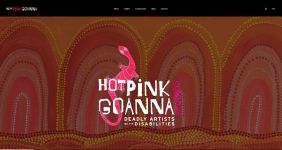 "Hot Pink Goanna Studios - Deadly With Disabilities, Website captured 2024" Hot Pink Goanna Studios: Deadly With Disabilities, website captured 2024 - with About, Gallery, Commisions, and Prints sections - reads, in part "Hot Pink Goanna was developed by Uncle Paul Constable Calcott a proud Wiradjuri man and artist living with a disability on Gubbi Gubbi Country. Hot Pink Goanna showcases the works of Uncle Paul and other First Nations artists living with a disability."
 -
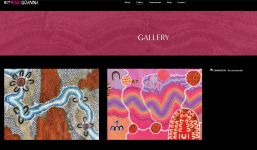 "Hot Pink Goanna Studios - Deadly With Disabilities, Gallery captured 2024" Hot Pink Goanna Studios: Deadly With Disabilities, Gallery captured 2024 - featuring imagews of works by Paul Constable Calcott
 -
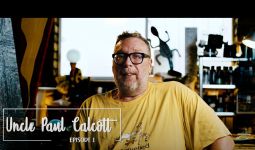 "Hot Pink Goanna Studios - Deadly With Disabilities - Walu Win Series by Uncle Paul Constable Calcott, Episode 1" Walu Win Series by Uncle Paul Constable Calcott, episode 1 - reads, in part "A mini-series exploring the benefits of art and how it is halping as a tool in the healing process. This episode is about Uncle Paul Calcott, a Wiradjuri man who is now living on Gubbi Gubbi country."
 -
 "It's Fine, I'm Fine - IMDB" It's Fine, I'm Fine' Internet Movie Database (IMDB) entry - reads, in part "A suburban psychologist and her patients explore love, loss, obsession, anxiety, and an uncertain future, while grappling with how to persist and find magic in the world."