
Items
Search full-text
Sit Down Shut Up and Watch
-
“Kate Larsen (2012) Disability Leadership: If You're Gonna Talk the Talk .... ABC: Ramp Up, March 30. https://www.abc.net.au/ram pup/articles/2012/03/30/3467 452.htm.” Reads, in part "Now, I love my job. I'm good at it. I think that I've been useful here. But on the same day I accepted the position last February I also did something else. I gave notice of my resignation, and undertook to hand over the organisation by the end of 2012. The reason? Because I believe that Arts Access Australia should be led by a person with disability."
-
"Bree Hadley, Gerard Goggin, Petra Kuppers, Colette Conroy, Meagan Shand, Donna McDonald, Martin Paten, Norm Horton, Sarah Moynigan, Veronica Pardo, Caroline Bowditch, Morwenna Collett, Kerry Comerford, David Doyle, Pat Swell, Clark Crystal, Peter Stuart (2019) The NDIS and disability arts in Australia: Opportunities and challenges. Australasian Drama Studies, 74, pp. 9-38." "In Australia, disabled people’s participation in the arts has historically been afforded by means of direct-to-organisation grants that arts, community services or disability services arms of government award to arts organisations, charities or disability service organisations, who then deliver programmes. The introduction of the National Disability Insurance Scheme (NDIS) is creating wide-reaching changes for disability arts practice in Australia. We undertake a first step in addressing the need for research into how the NDIS will alter the landscape of disability arts practice in Australia. We highlight a set of questions that all performing and creative arts industry stakeholders will need to respond to, in order to ensure that the excellent work done in disability arts in Australia to date can continue in the new climate that the NDIS brings."
-
"Australia Council for the Arts (2014) Australia Council Promotes Disability Leadership in the Arts. Australia Council for the Arts. 25 June 2014." Reads, in part "The Australia Council for the Arts is presenting a suite of activities from next month to develop the leadership skills of people with disability and enhance their access to leadership roles across the cultural sector."
-
"Katie Ellis (2016) Disability Media Work: Opportunities and Obstacles. London: Palgrave." Reads, in part "Elevates disability media discussions beyond representation and access by considering employment and discriminatory attitudes in the media industry"
- "Australian Institute of Health and Welfare (1993) Australia's welfare 1993: services and assistance. Canberra: AGPS."
-
"Juliette Peers (2022) The ArtLink Archive Project: Inside the 'Outsider' Issue, 42(2)" "In 1992–93 ArtLink published Naïve & Outsider Art centring on themes linked by their shared invisibility in mainstream discussions. While the title obviously references art historian Roger Cardinal’s 1972 book Outsider Art, (after Jean Dubuffet’s ‘Art Brut’ or ‘raw art’), this outlying status was described by ArtLink’s founding editor Stephanie Britton in 2022 as ‘…the context changes, but at the time the concept [of various practices lying beyond the mainstream] functioned as a catch up on things that had been under the radar for decades already... [we were] collating a wide range of ideas'[1], a group of practices that existed but were hardly recognised in published texts. Looking back across ArtLink’s history, Naïve & Outsider Art offers much to think through about the magazine’s own platform, intentions and the trajectories of those practices foregrounded thirty years ago under what are now troubling rubrics."
-
"Katie Ellis, Tama Leaver, Mike Kent, M, eds. (2023). Gaming Disability: Disability Perspectives on Contemporary Video Games. London and New York: Routledge." This book explores the opportunities and challenges people with disabilities experience in the context of digital games from the perspective of three related areas: representation, access and inclusion, and community. Drawing on key concerns in disability media studies, the book brings together scholars from disability studies and game studies, alongside game developers, educators, and disability rights activists, to reflect upon the increasing visibility of disabled characters in digital games.
-
"Queensland disability fact book for arts and cultural organisations - DADAA National Network and Australia Council (1998)" https://disabilityartshistoryaustralia.net/s/DAHA/item/9586
-
"New South Wales disability fact pack for arts and cultural organisations - DADAA National Network and Australia Council (1998)" Disability fact pack for arts and cultural organisations in New South Wales
-
"South Australia : disability fact pack for arts and cultural organisations - DADAA National Network and Australia Council (1998)" Disability fact pack for arts and cultural organisations in South Australia
-
"Northern Territory : disability fact pack for arts and cultural organisations - DADAA National Network and Australia Council (1998)" Disability fact pack for arts and cultural organisations in the Northern Territory
-
"Australian Capital Territory : disability fact pack for arts and cultural organisations - DADAA National Network and Australia Council (1998)" Disability fact pack for arts and cultural organisations in the Australian Capital Territory
-
"Western Australia : disability fact pack for arts and cultural organisations - DADAA National Network and Australia Council (1998)" Disability fact pack for arts and cultural organisations in Western Australia
-
"Sally Northfield (2014) Canvassing the Emotions: Women, Creativity and Mental Health in Context" PhD Thesis Victoria University, Melbourne, https://vuir.vu.edu.au/29985/, Australia, https://vuir.vu.edu.au/29985/1/NORTHFIELD%20Sally-thesis_nosignature.pdf " Reads, in part, "A multimedia movement-theatre show, incorporating dance, video- and slide- projections, a life-sized puppet and an original soundtrack. A diary come to life, portraying the true story of an Australian dancer who – after paralysing one of his arms in a motorcycle accident – journeys through the worlds of medicine, rehabilitation and disability, in recovery of self-expression. He finds new angles on perceiving the body, and new ways to move. "Body image" and concepts of "normality" are questioned."
-
"Bree Hadley (2007) Review - Mirage, by Igneous, Australian Stage Online" Reads, in part "In Mirage, a performance installation by Brisbane-based multimedia company Igneous, dancer James Cunningham uses a combination of dance and data projection to draw the audience into a strange new perceptual space, in which body parts can be transposed, twinned and mirrored, providing new capacity for movement in the face of challenges to a body’s conventional structure and integrity. The work, like Cunningham’s previous collaboration with multimedia artist Suzon Fuks on The Body in Question (1999), is based on Cunningham’s experience after a motorcycle accident in 1992 left him paralysed in his left arm. Both works touch on the perceptions and realities of the human body as it reacts, recovers and rediscovers its potentialities in the wake of injury"
- Carriageworks
-
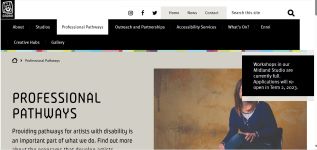 "DADAA Professional Pathways Webpage, captured 2023" DADAA Professional Pathways Webpage, captured 2023 - reads, in part "DADAA supports artists to develop professionally and to realise their dreams however big or small. To support you on your journey as an artist, we offer a range of programs at all levels so that you can progress as an artist as you learn and build your skills."
-
 "NuunaRon Art Group" Webpage for First Peoples Disability Network NuunaRon Art Group, with video introducing where Paul Constable Calcott introducing the group, reads in part "The NuunaRon Art Group operates the NuunaRon Hub on the sunshine coast, a welcoming and safe space for people to share stories of resilience and keeping strong via yarning, painting and creating art and be supported."
-
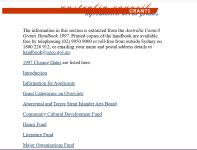 “Australia Council - Grants, captured 1997” Australia Council (Creative Australia) grants captured December 1997. Website reads “extracted from the Australia Council Grants Handbook 1997” and includes Grant Categories: an Overview, Aboriginal and Torres Strait Islander Arts Board, Community Cultural Development Fund, Dance Fund, Literature Fund, Major Organisations Fund, Music Fund, New Media Arts Fund, Theatre Fund, Visual Arts/Craft Fund, Awards
-
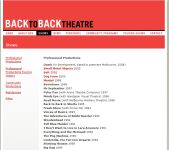 "Back to Back Theatre - Website - Shows, captured 2008" Back to Back Theatre 'Shows' page, captured 2008, with list of shows, and links to work from 1999 forward - Professional Productions (including ‘Big Bag’ 1987-88; ‘Stinking Houses’ 1989; ‘The Peg Machine’ 1990; ‘Everything and the Mermaid’ 1990, ‘I Don’t Want to Live in Lara Anymore 1991; ‘Yell Blue Murder’ 1991; ‘Woodenhead’ 1992; ‘The Adventures of Bobbi Dazzler’ 1992; ‘Voices of Desire’ 1993; ‘Freak Show with Circus Oz 1994; Back to Back in Shorts 1995; Road Movie with Melbourne Workers Theatre 1996; Minds Eye with Handspan Visual Theatre 1996; Peter Pan with Arena Theatre Company 1997; Mr September 1997; Boomtown with Snuff Puppets 1998; Mental 1999; Dog Farm 2000; Pornstar 2001; Soft 2002; Cow 2003; Small Metal Objects 2005), and Community Productions (including Ritual with Matthew Flinders Girls Secondary College 1998; Push Push 1999; Drag Racers in Love with Nelson Park School 1999; Arnold 2000 Fishman with Theatre of Speed 2001; Inside the Angel House with Theatre of Speed 2003; Minotaur with Theatre of Speed 2005; DMI with Theatre of Speed 2007; Pod Residences with Night School, Awakenings Festival, Brr Theatre Group, Ants Pantz Arts, Break of Day Players, Theatre of Speed, Arts Action and Amalgamation Festival 2003-2006), and films (including Mullet (1995), White Maggots (1996), Spill (1997), Mark Deans Human Cannonball (1998), Underpants (1999), Backscratch (2000), Porn Star (2002), Rhian Hinkley Theatre of Speed vs. BOZ'n'HOK, vs. HUGE COVILL (2004), D9 (2005), Out of our Minds (2001)).
-
 "Arts Access Victoria - History, captured 2011"
-
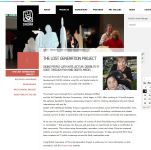 "DADAA - The Lost Generation Project" DADAA - The Lost Generation Project 2007 - reads, in part "The project was conceived from a partnership between DADAA and the WA Disability Services Commission, which began in 2002. After working on 15 small projects, the partners decided to develop a large-scale project in 2007 to continue developing arts and cultural interventions with and for people with intellectual disability living in supported accommodation across the Perth metropolitan area. The project's rich CACD strategy has seen numerous successful workshops, exhibitions and related projects come to fruition in partnership with local governments and other community arts organisations.?
-
 "Rawcus Website, captured 2014" Rawcus website, captured 2014, reads, in part, "Rawcus is an ensemble of performers with and without disabilities. Collaborating with a core creative team led by Artistic Director Kate Sulan, Rawcus aims to devise new work that expresses the imaginative world of the ensemble. Drawing on dance, theatre and visual art disciplines, the work is crafted with a precision that supports the performers but allows space for their inherent sense of anarchy. A series of moving pictures, Rawcus’ work is sculptural, unexpected, beautiful, funny and tender."
-
 "Igneous - Mirage" Reads, in part "A movement-based performance installation with video art, sound art and a series of mirror-booths. Taking phantom-limb sensation as a “body-mirage”, and inspired by the work of neurologist V. Ramachandran, Mirage plays on perceptual illusion, the construction of hybrid forms, and the real and virtual fusing and separating. It is an interactive labyrinth of perceptual illusion with the performer in a reflective pool amongst multi-dimensional projections. Mirage was created in the context of a fellowship awarded by The Australian Choreographic Centre to James Cunningham and Suzon Fuks."
-
 "Igneous - Body In Question" Reads, in part, "A multimedia movement-theatre show, incorporating dance, video- and slide- projections, a life-sized puppet and an original soundtrack. A diary come to life, portraying the true story of an Australian dancer who – after paralysing one of his arms in a motorcycle accident – journeys through the worlds of medicine, rehabilitation and disability, in recovery of self-expression. He finds new angles on perceiving the body, and new ways to move. "Body image" and concepts of "normality" are questioned."