
Items
Search full-text
Sit Down Shut Up and Watch
-
 "Tutti Arts - Tutti Voice Newsletter September 2009" Tutti Arts - Tutti Voice Newsletter September 2009 - reads, in part "Congratulations to Tutti's amazing team of staff, artists, and volunteers who have recently presented three outstanding artistic events: the lively and colourful launch of the Extensions exhibition at the Bay Discovery Centre for SALA, the Let it Shine concert on 19 July at Christ Church, North Adelaide, and an extraordinary work in progress performance of Doghouse aka The Psychology of Loneliness at Restless Big Space in June. Special thanks to Mel Fulton, Juha Vanhakartano, Philip Griffin, Daisy Brown, and Jonathan Bligh for their creativity and leadership of these profile-raising events."
-
"Making the arts work for everyone: a resource and information kit about arts and disabilities produced in 1995" Arts Access Victoria and Australia Council published 'Making the Arts Work for Everyone: A Resource and Information Kit about Arts and Disabilities' in 1995.
-
"1963 and 1967 sees the introduction of the Disabled Persons Accommodation Act and Sheltered Employment (Assistance) Act, respectively." With increasing pressure to provide more services to people with disabilities, the 1960s was a decade of Commonwealth Government initiatives to support organisations providing work and accommodation to people with a disability, including the Disabled Persons Accommodation Act and Sheltered Employment (Assistance) Act.
-
"The Australia Council establishes the Community Arts Committee in 1973 and the Community Arts Board in 1978" The Australia Council established the Community Arts Committee in 1973 and the Community Arts Board in 1978. The purpose of the latter was to encourage wider participation in the arts, especially for groups with little social capital. The Board was “the first funding body to identify the community arts phenomenon and respond with definition and policy." This occurred under the directorship of Rosalie Bower, the first director of the Community Arts Board, who wrote in a paper entitled 'The Case for a Community Arts Centre': “The activities within a centre should be accessible to children, aged people, the physically handicapped, ethnic groups and those whose time is severely restricted by work and family ties. The activities supplied by the centre should be conducted free from competitive elements which otherwise might discourage people from participation, and they must be inexpensive and accessible at almost any time. They must not pre-suppose education or income levels which would cut them off from any section of the community.'" (Australia Council 1979/1980 Annual Report, page 32)
-
“Australia Council grants funding for projects about disability or for disabled participants throughout the 1970s” The 1974/75 Australia Council annual report states $1,350 in funding granted to Spectrum Films (NSW) to "develop a screenplay for a feature film of the social pressures on a deaf mute”, as well as a $4,500 travel/study grant to Lloyd Nickson (QLD) "to attend summer schools in children's theatre and theatre for deaf children (USA and UK) for six months". In the same year, the Council reported Bryan Gracey as one of numerous individuals in receipt of Experimental Film funding for his short film ‘The World of a Blind Child’ (1975) about the emotional and physical difficulties 10-year-old Peter faces and how he navigates his disability. In the 1974/75 financial year, Australia Council’s crafts board awarded $1,288 to the Wheelchair and Disabled Association (NSW) for "Jewellery making tools and equipment". The 1979/1980 Australia Council annual report describes the following funding: "As in previous years, a grant was given to the Braille and Talking Book Library for its Braille Book of the Year.”
-
“Australia Council praises NSW Theatre of the Deaf and provides some funding to the Deaf theatres throughout the 1970s” The 1976/77 Australia Council annual report stated: "The NSW Theatre of the Deaf is a significant achievement. The only funded organisation in Australia working in nonverbal theatre, its production of King Lear received widespread praise. This company is now accepted as operating in a legitimate area of theatre rather than performing mime works for the deaf. This offers wide scope for innovation." The Council’s 1977/78 annual report recorded that it granted funding to the NSW Theatre of the Deaf “towards salaries of artistic director, deaf director, and tutors’ fees in 1978” for $25,000; the “presentation of theatre pieces (mime, clowning, puppetry) in public performance” for $2,500, and “towards costs of a production in 1978” for $4,000. It also awarded $1,980 to Queensland Theatre of the Deaf “towards the cost of transporting company to Sydney for seminar with NSW Theatre of the Deaf”. Drama Resource Centre (Victoria) received $2,840 “to develop student theatre at Victoria School for Deaf Children” and $630 went to Children’s Activities Time Society (Western Australia) for the “cost of deaf mime artist, Rae Gibson, to undertake four week visit to Melbourne and Sydney to work with deaf artists”. The following annual report for 1978/79 recorded that the Council granted $25,000 to the NSW Theatre of the Deaf “towards salaries of artistic director, administrator and tutors” in 1979. The Council also awarded $1,800 to the Queensland Theatre of the Deaf towards a salary for Geoffrey Rush to work with the company in 1979. The 1979/1980 Australia Council annual report mentions funding “provided for a playwright-in-residence at the NSW Theatre of the Deaf.”
-
“Melbourne venue guides published in the 1990s” Arts Access Victoria published the ‘Melbourne Venue Guide: A Description of Access for People with Disabilities to Some of Melbourne's Major Entertainment Venues’ in 1992. They published an updated guide in 1998: ‘The Vic Venue Guide: A Guide to Access and Facilities at Over 75 Victorian Entertainment, Sporting and Cultural Venues’. This updated guide was produced in conjunction with VicHealth and supported by Arts Victoria. The guide provided information about where to make bookings, parking and public transport, facilities and access for disabled patrons, and seating.
-
“Choose Art, the Australian accessible arts directory, is launched” The Australian accessible arts directory Choose Art was launched in 2019. It is an initiative of Arts Access Victoria, designed for and by Deaf and disabled people. Choose Art is a Commonwealth project supported by the Cultural Ministers of each State and Territory through Arts ACT; Arts Tasmania; Create NSW; Creative Victoria; Culture and Arts WA; Arts South Australia; Arts Queensland; Department of Tourism and Culture, NT and the Federal Minister through the Department of Communications and the Arts. Arts Access Victoria has created Choose Art in partnership with Arts Access Australia, Access2Arts, Access Arts, Accessible Arts, Arts Access Darwin, Belconnen Arts Centre, DADAA and Incite Arts.
-
"Sarah Austin, Chris Brophy, Lachlan MacDowell, Edward Paterson, and Winsome Roberts (2015) Beyond Access: The Creative Case for Inclusive Arts. Melbourne: Arts Victoria." Reads, in part "Beyond Access sought to create an evidence base for the creative case for inclusive arts practice to support greater recognition for artists with a disability by transforming and extending notions of what art is and who produces it."
-
"Hickey Moody, Anna. 2009. Unimaginable Bodies: Intellectual Disability, Performance and Becomings. Rotterdam: Sense." Reads, in part "Unimaginable Bodies radically resituates academic discussions of intellectual disability. Through building relationships between philosophy, cultural studies and communities of integrated dance theatre practice, Anna Hickey-Moody argues that dance theatre devised with and performed by young people with and without intellectual disability, can reframe the ways in which bodies with intellectual disability are known."
-
"Anthea Skinner, Jess Kapuscinski-Evans (2021) Facilitate This! Reflections from Disabled Women in Popular Music. Journal of Popular Music Studies 1 June 2021; 33 (2): 3–14. doi: https://doi.org/10.1525/jpms.2021.33.2.3" Reads, in part "This article is a reflection by the authors on the impact that their identities as disabled women have had on their ongoing music careers. Skinner and Kapuscinski-Evans make up two-thirds of the Australian crip-folk trio, the Bearbrass Asylum Orchestra (the term “crip” is a cultural reappropriation of “cripple”). The Bearbrass Asylum Orchestra is a band that performs as part of the Disability Music Scene in Melbourne, Australia, using folk music to portray their experiences as people with disabilities. In this article Skinner and Kapuscinski-Evans discuss the formation of and philosophy behind the band, as well as the impact that growing up as disabled women had on their musical education, careers, and influences."
-
"Anthea Skinner (2017) ‘I love my body’: Depictions of sex and romance in disability music culture. Sexualities. Volume 21, Issue 3. https://doi.org/10.1177/1363460716688" Reads, in part "The international disability music scene is a thriving musical subculture consisting of performers self-identifying as disabled who use their performances to explore experiences of living with disability. As a genre predominantly written by, about and for people with disabilities, it provides a space for discourse about life with disability which is largely unmediated by governmental policy, political correctness or able-bodied facilitators. As such, it is a medium through which people with disability are free to express opinions about sex and romance rarely seen in mainstream media. This article examines the ways in which the topics of sexuality and romance are explored within disability music culture."
-
"Katie Ellis, Gerard Goggin (2015). Disability media participation: Opportunities, obstacles and politics. Media International Australia, 154 (1), pp. 78-88." This article discusses participatory media from a critical disability perspective. It discusses the relative absence of explicit discussion and research on disability in the literatures on community, citizen and alternative media. By contrast, disability has emerged as an important element of participatory cultures and digital technologies. To explore disability participatory cultures, the article offers analysis of case studies, including disability blogs, ABC's Ramp Up website and crowd-funding platforms (such as Kickstarter).
-
"Australia Council: Australian Arts Snapshots - Disability & the Arts (2002)" Reads, in part "Australians who have a disability are recognised as being creators of innovative, thought provoking, high quality, and often very irreverent artistic product. They are active across all artforms in mainstream and community arts contexts"
-
"Katherine Gale (2013) Review - Take Up Thy Bed and Walk, Arts Hub" Review of 'Take Up Thy Bed and Walk' (2013) by Vitalstatisix and Gaelle Mellis - reads, in part "The latest Vitalstatistix Theatre Company production asks subtle questions about society’s perception of people with disabilities."
-
"David Throsby and Virginia Hollister (2003) Don't give up your day job: an economic study of professional artists in Australia, Australia Council" Australia Council- Don’t give up your day job: An Economic Study of Professional Artists in Australia' (Throsby and Hollister 2003) based on 2002 Survey - The website reads “The 2002 Australia Council artists survey, Don't give up your day job collected information relating to practising professional artists in Australia…..According to Don't give up your day job, about 10 per cent of practising professional artists live with a disability.”
- High Beam Festival
- Donna McDonald
- Eddie Paterson
-
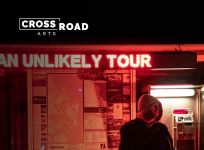 "Crossroad Arts StrategicPlan 2022-2025" Crossroad Arts Strategic Plan 2021-2025 - includes Vision, Mission, and Goals, Artistic Program and Artists, Community, Markets, Board and Staff, Partners, Impact
-
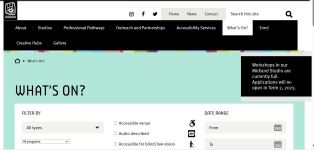 "DADAA What's On Webpage, captured 2023" DADAA What's On Webpage, captured 2023 - includes a search function, with filters for venue accessible, blind/low vision accessible, audio described, and braile events
-
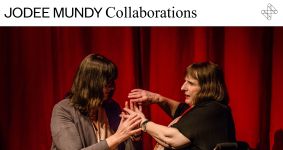 "Jodee Mundy Collaborations - Imagined Touch - Live Show" Reads, in part "Imagined Touch is a multi-sensory arts performance project exploring the fascinating world of Deafblind culture with its own tactile sign language, unique relationship to the senses, space and navigation of the world."
-
 “Arts Access Victoria – Growth and Opportunity (Early 1980s)” Arts Access Victoria – Growth and Opportunity (Early 1980s) – Funding from Australia Council for the Arts enabled program and performance for IYPD AAV – “Theorem” a theatre show with Chilean Theatre Director Aldo Gennaro including over 100 performers.
-
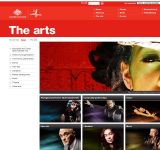 “Australia Council – The Arts, captured 2010” Website includes: The arts, Aboriginal and Torres Strait Islander Arts, Artists and organisations, Community partnerships, Dance, Inter-arts, Literature, Market development, Music, Theatre, Visual arts
-
 “Australia Council - Artists with Disability Program 2014” The website reads “The Artists with Disability Program provides funding for Australian artists with disability (including Deaf artists) to create, develop, present, produce, exhibit and/or tour their work”