Items
Search full-text
Sit Down Shut Up and Watch
-
 "Tutti Arts - Choir - Winter Concert - Promotional Flyer & Program" Tutti Arts Choir 'Winter Concert' 2006 Promotional Flyer & Program
-
 "Weave Movement Theatre - Done to Perfection - 2012" Image of work - Weave Movement Theatre - Done to Perfection - 2012
-
 “Arts Access Victoria – Bandmates Victoria - Promotional Card 2"
-
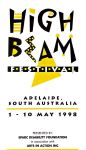 "High Beam Festival 1998 Poster" High Beam Festival Poster 1998 reads "High Beam Festival PRESENTED BY: SPARC DISABILITY FOUNDATION in association with ARTS IN ACTION INC"
-
"Australia Council commissions a research study on people with disabilities' participation in arts activities" Australia Council commissioned a research study on the problems faced by people with disabilities attempting to participate in art activities (Australia Council Annual reports 1979/1980 and 1980/1981).
-
"National Inquiry into the Human Rights of People with Mental Illness Report launched in 1993" The National Inquiry into the Human Rights of People with Mental Illness Report was launched 20th October, 1993. This led to deinstitutionalisation.
-
"The Australian Elizabethan Theatre Trust begins operations in 1954" The Australian Elizabethan Theatre Trust began operations in 1954. The key role of the trust was to support the arts in Australia leading to the independent companies of: Opera Australia, The Australian Ballet Foundation, National Institute of Dramatic Art (NIDA), and Bell Shakespeare Company. At this time there was little involvement of people with disabilities in the arts.
-
"Royal Commission on Human Relationships" In 1977, the Royal Commission on Human Relationships noted the legal and human rights of handicapped children and adults.
-
“Senator Margaret Guilfoyle creates a committee of people with disabilities representing their own interests” In 1979, Senator Margaret Guilfoyle, the Federal Minister for Social Security created a committee of people with disabilities representing their own interests. This followed a complaint by Richard Llewellyn that he was the only token disability representative. This committee led to the formation of formal advocacy groups such as People with Disability Australia (PWDA) and Disability Resource Centre (DRC). The PWDA celebrated their 30th year anniversary in 2011.
-
“Alan Marshall writes ‘I Can Jump Puddles’ in 1955” Alan Marshall wrote 'I Can Jump Puddles' in 1955., the first in a series of works about growing up with a disability. The subsquent books were 'This Is the Grass' (1962), 'In Mine Own Heart' (1963), and 'Hammers Over the Anvil' (1975). Marshall contracted polio at age six and became physically disabled.
-
“Documentary ‘Stepping Out’ follows first group of intellectually disabled people to perform at the Sydney Opera House” In preparation for the International Year of Disabled Persons, a documentary was made called ‘Stepping Out’ directed by Chris Noonan and narrated by Romayne Grace, a resident at the Lorna Hodgkinson Sunshine Home. The documentary follows a group of residents as they prepare for their big debut at the Sydney Opera House. The movie was shown during the International Year of the Disabled's UN closing ceremony. The 1979/1980 Australia Council report had the following statement "A production staged at the Sydney Opera House by residents of the Lorna Hodgkinson Sunshine Home for the intellectually handicapped impressed the Theatre Board as both innovative arts-based therapy and worthwhile theatre in its own right." The 1980/81 report further stated "It was the first time anywhere in the world that a group of mentally handicapped people had performed publicly in the cultural centre of their city."
-
"Kevin Byrne AM leads protest outside Parliament House" The activist Kevin Byrne AM led a protest outside Parliament House. This coupled with the release of the Richmond Report led to the Hawke Government’s Handicapped Programs Review, which in turn led ‘New Directions: Report of the Handicapped Programs Review’.
-
“Inaugural High Beam festival in 1998” High Beam was a biennial community-based disability arts festival. It was a joint initiative of SPARC Disability Foundation and Arts In Action (through the direction of Tony Doyle). (Arts in Action later became Arts Access SA.) The 10-day event was the first of its kind in the Southern hemisphere, attracting around 20,000 people at each festival. The festival showcased theatre, dance, comedy, and music. Some celebrity artists included Adam Hills and David Helfgott. The inaugural festival (1998) invited Swedish Disability Theatre Company Mooms Teatern to perform; the company also conducted workshops with a disability-led Australian theatre company, No Strings Attached. This first festival was also the site of Tutti's first public performance as a choir.
-
“Disability in the Arts, Disadvantage in the Arts, Australia (DADAA), based in Western Australia, is established in 1994” The National Participate Conference, hosted by Arts Access Victoria in 1990, set the scene for the emergence of the DADAA network. This came after several years of conversations among Western Australian artists about starting an organisation; the organisation was officially established in 1994. “In 1986, a small group of artists with disability met to discuss starting their own WA-based arts organisation. It is from this meeting that DADAA slowly grew, from a pilot project it became an organisation in its own right in 1994: taking the name Disability in the Arts, Disadvantage in the Arts, Australia – DADAA.”
-
“Advocates fight for accessible public transport” In 1994, Maurice Corcoran (a wheelchair user) lodged a complaint about the South Australian government ordering 50 new buses that were not accessible. The Australian Human Rights Commission successfully negotiated for all new buses to be fitted with ramps. Then, in 1999, a protest about the lack of public transport options for people with disability saw Citizens for Accessible Public Transport block traffic in Sydney’s city centre.
-
"A number of theatre companies are established in the 2000s" A number of theatre companies were established in the 2000s, particularly towards the end of the decade. Some key companies in disability theatre or inclusive arts practice to emerge in the 2000s are: Second Echo Ensemble (2005, integrated, often producing work in partnership with the Tasmanian Theatre Company), Ever After Theatre Company (2006, performers with disability), Rollercoaster Theatre Company (2007, performers with disability), DirtyFeet (2008, inclusive), and Blue Roo Theatre (2009, performers with disability).
-
"Access2Arts (SA) established in 2009" Access2Arts (SA) was established in 2009. In their own words, “following on from many years of work by the Community Arts Network SA (CANSA), a project was created within Arts SA called the Disability Arts Transition Team. This led to our establishment as an independent body to represent, advocate and respond to the needs of the arts and disability sectors.” The organisation became incorporated in 2013. They are the body for arts and disability in South Australia.
-
“The 2010s sees numerous new disability performing arts companies established” The 2010s saw the establishment of several new disability performing arts companies and collectives, both professional and community-based, across the country: Beyond the Square (NSW, 2011), ‘stArts with a D’ Performance Ensemble (NT, 2011), Theatre on Wheels (VIC, 2011), Can You See Me? Theatre (NSW, 2012), Company AT (SA, 2012), Sprung!! Integrated Dance Theatre (NSW, 2013), Screech Arts (QLD, 2014), IndelibilityArts (QLD, 2015), AHA Ensemble (QLD, 2015), Murmuration (NSW, 2015), Raspberry Ripple (VIC, 2015), Deafferent Theatre (VIC, 2016).
-
“Office of the Arts releases 'Creative Australia – National Cultural Policy' (2013) , is critiqued for its reference to 'tolerance' of disabled people” The national cultural policy ‘Creative Australia’ was published in 2013. It was critiqued for its lack of disability arts funding and its reference to 'tolerating' disabled people. As Arts Hub reported, “By now you will have heard that the National Cultural Policy offers little for Australians with a disability. Not only is there no funding for the National Arts and Disability Strategy, but instead, the policy calls for a culture of tolerance towards people with a disability.”
-
“The arts sector is forced to adapt in the face of COVID-19 lockdowns” Government-enforced lockdowns in response to the COVID-19 pandemic saw arts events cancelled and disability arts organisations temporarily close physical premises as social distancing rules came into play. While Coronavirus 19 restricted social contact, there were some benefits that arose such as increased digital access for social connection, online ordering accessible via screen readers and home delivery, virtual tours of art galleries, online choirs, and telehealth appointments.
-
“Off The List Records (VIC) established in 2020” Off The List Records (VIC) was established in 2020. Their Facebook page describes them as “an access-friendly and disability-led record label, working within the DIY, experimental and indie music scenes in and around Naarm.”
-
“Deaf film ‘A Silent Agreement’ is released in 2017” The Deaf film ‘A Silent Agreement’ was released in 2017 (written and directed by Davo Hardy). This romantic drama features a profoundly Deaf human rights activist and his filmmaker boyfriend with a speech impediment. It is said to be the first Australian film to feature Auslan as the main dialogue. Some scenes are entirely in Auslan. Screen Australia calls it the “first Australian film to feature Auslan.”
- Undercover Artist Festival
- Indelability Arts
- Blue Roo Theatre Company