Items
Search full-text
Sit Down Shut Up and Watch
-
 "Access Arts Annual Report 2008" Access Arts Annual Report 2008 - Indigenous Projects, Brisbane Outsider Artists (BOA), Professional Development Mentoring Program, Sound Circles, Conferences, Events and Celebrations, Workshops, Projects, Partnerships
-
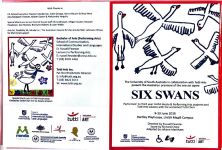 "Tutti Arts - Six Swans - Program" Tutti Arts ‘Six Swans’ 2015 Program – reads, in part “Six Swans is the first collaboration of its kind and we are thrilled to be working together on this production. Tutti is one of Australia's leading disability arts organisations- working to promote the work of disabled artists to the world, and UniSA is at the forefront of providing flexible, compelling industry-relevant learning experiences for students. Productions of this nature are immensely valuable because they break down barriers, enrich the lives of all participants, and create opportunities for graduating and emerging artists involved.”
-
"Bree Hadley (2015) Participation, politics and provocations: People with disabilities as non-conciliatory audiences. Participations: journal of audience and reception studies, 12(1), pp. 154-174.” "Disability has always had a prominent place on the theatrical stage. Throughout the C19th, C20th and C21st to date, disabled characters have been used to signify corruption, innocence or suffering, and, of course, as salutary examples of how to overcome such suffering. In the past three decades, the work of disability scholars, activists and artists has also provided opportunities for people with disabilities to produce their own plays, performances or installations challenging these stereotypes. Interestingly, though both the body of literature on theatre makers with disabilities and the body of literature on theatre audiences has grown apace over the past decade, there is still surprisingly little written on people with disabilities as theatre audiences. In this article, I draw on observations made during five years of practical, empirical and theoretical research into disability theatre to discuss how people with disabilities work as a distinctive sub-group of spectators, with distinctive spectatorial processes, modalities and preferences, within contemporary theatre audiences. I begin with the factors that make attending theatre difficult for people with disabilities. I note that people with disabilities respond to the challenges they face in attempting to become active audiences of contemporary theatre in three common ways. I then unpack what these spectatorial modalities teach us about people with disabilities as audiences, other marginalised groups as audiences, as well as about audiences, audiencing and the part audiences play in theatre practice more generally."
-
"Commonwealth of Australia, 2018. Research Overview: Arts and Disability in Australia. Barton: Department of Communication and the Arts, Cultural Ministers Council. Available from: https://www.arts.gov.au/sites/g/files/net1761/f/research_overview_of_arts_and_disability.pdf." Reads, in part "The Research Overview brings together published and unpublished data and research about arts and disability in Australia, and case studies highlighting arts and disability practice around the country. The Research Overview is part of the evidence base for a renewed National Arts and Disability Strategy. The evidence gathered here will be complemented by submissions and survey during a national consultation in 2018."
-
"Queensland Government (2024) Arts and Disability Plan. 25 September 2024. https://www.arts.qld.gov.au/projects-and-initiatives/arts-and-disability-plan-web" Reads, in part "The Queensland Government acknowledges the rights of people with disability to participate equally in the state’s cultural life and to have the opportunity to develop and use their creative, artistic and intellectual potential, as recognised in the United Nations Convention on the Rights of Persons with Disability."
-
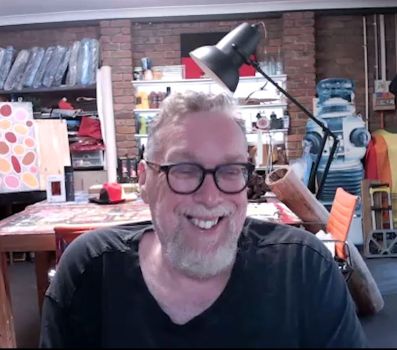 "Interview with Paul Constable Calcott" Uncle Paul Constable Calcott is a proud Wiradjuri man and artist living with a disability on Gubbi Gubbi country….. Uncle Paul uses his art to share stories of his journey as an aboriginal gay man living with a disability in urban Australia. Interview Summary Uncle Paul Calcott is a proud Wiradjuri elder and disability advocate who contracted polio as a child. During the interview, Uncle Paul discusses becoming an artist later in life through the encouragement of his husband and influenced by the storytelling of his culture. He embraces his identity as an Aboriginal, gay man living with disability. He talks about his artwork aiming to celebrate the achievements and contributions of people with disabilities, using traditional symbols to tell new stories, particularly about disability within Indigenous communities. Although there has been increased visibility and acknowledgment of disability arts in Australia, Paul notes that there's still a long way to go in terms of policy, funding, and public recognition. Uncle Paul says art can reflect political and social issues, and he proudly identifies as an artist with a disability and believes in the significance of diverse stories being told through the arts.
-
 "Australia Council - Annual Report 1985-86" Australia Council Annual Report 1985-86 - discusses functions and objectives, structures, process and membership of Council, Council Committees and members, Board Members, Assessment panels, staff lists, organisation chart, main activities of Council and its Boards, and includes financial statements and lists of grants made including grants for programs, workshops, tuition and skill development for disabled people in community arts, grant for Theatre of the Deaf Playwright, travel/study grant, Braille Book of the Year award and establishing audio visual gallery accessible to deaf and blind.
-
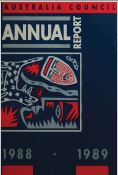 "Australia Council - Annual Report 1988-89" Australia Council Annual Report 1988-89 - discusses objectives, Council Committees and members, board members, allocation chart, main activities of Council and its Boards, and includes financial statements and lists of grants made including grants for community cultural development traineeships, training, programs, projects, performances and promotion and publications including “The Arts and People with Disabilities: A code of practice for arts organisations.”
-
 "Australia Council - Annual Report 1989-90" Australia Council Annual Report 1989-90 - discusses objectives, highlights, support for artform development, main activities of Council and its Boards, and includes financial statements and lists of grants made including grants for conferences, access and touring, programs training and resource development as well as publications such as “The Arts and People with Disabilities”
-
 "Incite Arts - Unbroken Land 2020 Episode Three - Flood Audio Described" Incite Arts - Unbroken Land 2020 Episode Three 'Flood' Audio Described - Reads, in part "As part of the Unbroken Land 2020 program, the ‘stArts with D’ Performance Ensemble have created a series of short films, telling their stories about water. From the dramatic storms with thunder and lightning, water flowing from the sky and flooding the rivers, to that good feeling of the rain on your skin…Water everywhere!"
-
 "Incite Arts - Unbroken Land 2020 Episode Five – Rain" Incite Arts - Unbroken Land 2020 Episode Five 'Rain' -Reads, in part "As part of the Unbroken Land 2020 program, the ‘stArts with D’ Performance Ensemble have created a series of short films, telling their stories about water. From the dramatic storms with thunder and lightning, water flowing from the sky and flooding the rivers, to that good feeling of the rain on your skin…Water everywhere!"
-
 "Incite Arts - Unbroken Land 2016" Incite Arts - Unbroken Land 2016 - reads, in part "The vision for this years’ UNBROKEN LAND was to create art that is about a world we want to live in and not the one that is currently shown us in much of popular culture. So much is overwhelmingly negative and self-perpetuating. We are told we are a divided, racist, intolerant and bigoted society."
-
 "Incite Arts - Unbroken Land 2020 Episode Four – Storm Audio Described" Incite Arts - Unbroken Land 2020 Episode Four 'Storm' Audio Described - Reads, in part "As part of the Unbroken Land 2020 program, the ‘stArts with D’ Performance Ensemble have created a series of short films, telling their stories about water. From the dramatic storms with thunder and lightning, water flowing from the sky and flooding the rivers, to that good feeling of the rain on your skin…Water everywhere!"
-
 "Hannah Gadsby: Something Special | Official Trailer | Netflix" Hannah Gadsby: Something Special | Official Trailer | Netflix - Netflix.com/HannahGadsbySomethingSpecial - reads,in part "Emmy and Peabody Award winning comedian Hannah Gadsby is back for their third Netflix comedy special, Something Special, and it's a feel good show. Seriously. In this smart and dare we say...feel good set, the comedian talks about a wedding (theirs!), more than one traumatic encounter with a bunny and much more. Filmed at the Sydney Opera House, Something Special premieres globally on Netflix on May 9."
-
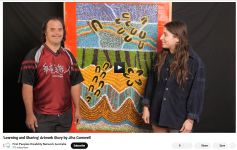 "NuunaRon Art Group - ‘Learning and Sharing’ Artwork Story by Jiha Cornwell" First Peoples Disability Network NuunaRon Art Group - ‘Learning and Sharing’ Artwork Story by Jiha Cornwell - reads, in part "The 'Culture is Inclusion' art exhibition showcases art work by the NuunaRon First Nations art group, with a lived experience of disability, telling their stories of resilience and strength through connecting to their culture"
-
 "Blue Roo Theatre Company - You Tube - NOW (2017)" Blue Roo Theatre Company - You Tube - main house production 'NOW' original story devised and performed the company (2017) - reads, in part "Blue Roo Theatre Company Inc. proudly presents, NOW. Channel Blue Roo presents The Now Show with their adorable hosts, Maggie Moment and Tony Today. Unflinchingly honest and tenderly inspiring, NOW is a modern-day fable exploring protests, bus stops, fishing, the mystery of grief and the joy of memories. All surrounded by a sublime 10-piece live studio orchestra of leading Brisbane musicians."
-
"International Year of the Disabled Person (IYDP)" In 1976, the General Assembly proclaimed 1981 would be the Year of the Disabled Person. The 1981 International Year of the Disabled Person inspired an increase in awareness and disability arts. While UN theme was “full participation and equality” the theme in Australia was “Break down the Barriers”, raising the prole and issues of people with disabilities. The international year of the disabled persons was a catalyst for connecting Australian disability activists to each other and the international disability rights movement (Royal Commission, 2021, p. 6). Australia saw an increase in disability-themed theatre from 1981 to 1984; however, these performances were largely staged with non-disabled casts. Records of these productions can be found on the AusStage database.
- Access Arts
-
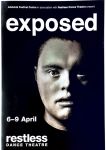 "Restless Dance - Exposed Program" Restless Dance Theatre Program 'Exposed' - reads, in part “Most of us are free to make choices about what parts of our life we keep private and what is public. But for some, this choice Is often not so straight forward We need to rely on others, sometimes strangers to help us with moments in life that you might take for granted And if we are lucky, we win have people around us who we trust. Trust is built slowly over time, relinquishing ourselves to the hands of others. With our backs to !he wall creating edges and boundaries, we build a community around us to keep our fragility protected is when we feel safe enough to let our guards down, we can show the little pieces of ourselves that are our most personal To be brave, yet vulnerable, is when we feel safe and not exposed.”
-
 "Juliet London and Des Walsh (1995) Arts & Disability: Report Australia Council: Surry Hills." Juliet London and Des Walsh - Arts & Disability, Australia Council 1995 - Reads, in part "The Australian Bureau of Statistics estimates that 18 per cent of the Australian population has a disability. There is a basic lack of data on participation in the arts by artists with a disability. No figures were available on the number of people with disabilities applying for grants from the Australia Council or from State or Territory arts agencies. The current dearth of statistical information needs to be overcome by systematic and sustained research."
-
"Bree Hadley, Eddie Paterson, Madeleine Little, Kath Duncan (2024) How Disability Performance Travels in Australia: The Reality Under the Rhetoric. In Czymoch, Christiane, Maguire Rossier, Kate, & Schmidt, Yvonne (Eds.) How Does Disability Performance Travel?: Access, Art, and Internationalization. Routledge, Abingdon, Oxon, pp. 62-76.” "The last three decades has witnessed the development of a distinct narrative about how disability performance has become a much celebrated component of the Australian theatre landscape. A central aspect of this narrative is the critical importance of festivals, events, and other industry initiatives that allow disabled performers to travel - both conceptually and corporeally - to meet and be mentored by other artists, and to present their work to new and more mainstream audiences, in new spaces and places, around the country, and around the world. In this chapter, we draw on historical data, collected as part of an AusStage ARC LIEF project designed to database information about disability drama, theatre, performance, and dance over the past 100 years, as well as the Last Avant Garde ARC Linkage project on disability performance in Australia, to unpack areas where the reality seems to challenge some of the dominant rhetoric."
-
”Racheal Missingham, Bree Hadley (2022) Oppression and allyship in Australia's Deaf Arts. Australasian Drama Studies, 80, pp. 304-332.” "In this article, we investigate the history of Deaf theatre in Australia, through the lens of oppression and allyship. Through a review of the to date limited academic, industry, and media literature, in conjunction with survey and interview research with Deaf theatre practitioners, this research sheds light on Deaf theatre makers’ perceptions of the ways in which ally support can operate to create both social benefits and barriers, and how this has impacted on the non-linear development and recent decline in Deaf theatre companies in Australia. It finds that, in developing a framework to scaffold stronger allyship relationships with d/Deaf and hard of hearing artists, it is critical to consider the accessibility and cultural requirements not just in relation to theatre methodologies, but in relation to arts management practices, which support continuing company production, too."
-
"Bree Hadley, Donna McDonald, Sarah Austin, Kath Duncan, Gerard Goggin, Lachlan MacDowall, Veronica Pardo, Eddie Paterson, with collaborators Dave Calvert, Jori De Coster, Shawn Goh, Alice Fox, Ann M. Fox, Andy Kempe, Petra Kuppers, Justin Lee, Alex Lubet, Sarah Meisch Lionetto, Ann Millett-Gallant, Laura Misener, Bronwyn Preece, Megan Strickfaden, Joanne Tay, Matthew Reason, Nancy Quinn, and Sarah Whatley (2019) Conclusion: practicing interdependency, sharing vulnerability, celebrating complexity - the future of disability arts, culture, and media research. In Hadley, B & McDonald, D (Eds.) The Routledge handbook of disability arts, culture, and media. Routledge, United Kingdom, pp. 362-372." "In this chapter, the authors conclude The Routledge Handbook of Disability Art, Culture, and Media studies by reflecting on the past, present, and potential future of disability art practice debated throughout the book. Based on research currently underway in the work of many of the Australian contributors, and including reflections from the global contributors, this concluding chapter reflects on what the disability arts, culture, and media practice and research of the future might look like, do, and achieve in the public sphere."
-
"David Throsby, Katya Petetskaya (2024) Artists as Workers: An Economic Study of Professional Artists in Australia, Creative Australia, 2024." "Artists as Workers: An Economic Study of Professional Artists in Australia, by David Throsby and Katya Petetskaya, is the seventh in a landmark study, carried out independently over the last four decades by Professor Throsby and colleagues at Macquarie University, with support from Creative Australia (previously the Australia Council for the Arts). Conducted at roughly six–year intervals, the series tracks the working conditions of artists, providing information about their artistic practice, income, career development and pathways, and their broader working lives. The latest survey was in the field late 2022 and early 2023 and examines activity in the 2021-22 financial year. This edition therefore captures the conditions for artists in the wake of COVID-19 and coincides with the Australian Government’s January 2023 announcement of its five-year national cultural policy Revive: A place for every story, a story for every place."
- Disability and Arts Disadvantage and the Arts Australia (DADAA)