Items
Search full-text
The Other Film Festival
-
 "Accessible Arts - Annual Report 2013"
-
 "Accessible Arts - Annual Report 2017" Accessible Arts - Annual Report 2017 - Corporate Information, Directors' Report, Statement of Financial Position
-
 "Accessible Arts - Annual Report - Yearly Report - 1992"
-
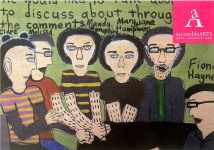 "Accessible Arts - Promotional Card- 2008-09" Accessible Arts - PromotionalFlyer - 2008-09 - reads, in part "assist Artists with disabilities develop professionally Arts organisations with access strategies Arts initiatives inclusive of people with disability Festivals and venues expand audiences"
-
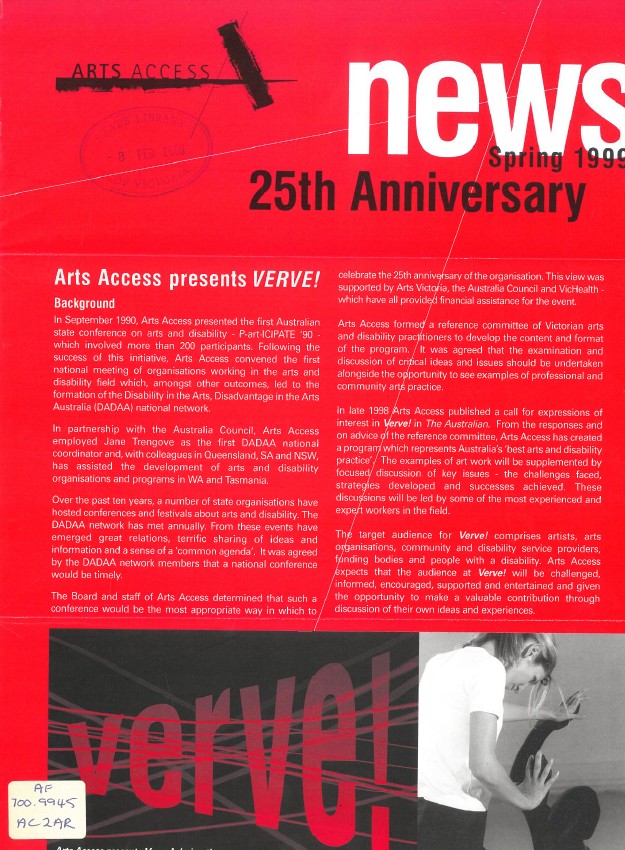 “Arts Access Victoria - Access Newsletter Spring 1999”
-
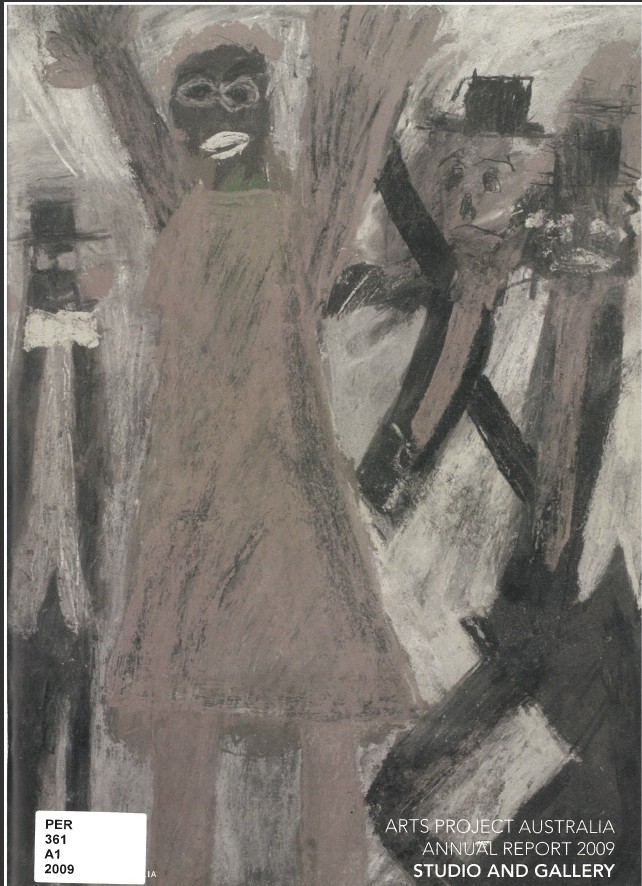 "Arts Project Australia - Annual Report 2009" Arts Project Australia - Annual Report 2009 - About Arts Project Australia, President's Report, Director's Report, The Studio, Board, Staff, Volunteers and Supporters, Exhibitions Report, Studio Artists, Financials - reads, in part "To support people with disabilities to become practitioners in the visual arts and to promote their work as integral to the broad spectrum of contemporary arts practice."
-
 "Australia Council - Annual Report 2007-08" Australia Council Annual Report 2007-08 - discusses letter from chairman, year in review, from the CEO, Excellent and Distinctive Art from various artforms, Access for all Australians from various artforms, A strong and vibrant arts sector including artist’s earnings, philanthropic support and arts sector development, About the Australia Council, Governance, Organisation, Accountability, Workplace and Financial statements but no longer listing grants of organisations or individuals however discusses the DADAA WA radio play “The Proper Shoes” - a series of stories written by young women with a disability, was first broadcast nationally on ABC Radio and then invited to tour the play as part of the TRASNA Festival of Inclusive Theatre.
-
 "Crossroad Arts Annual Report 2011" Crossroad Arts Annual Report 2011 - Artistic Director/CEO Report, history, program, key statistics for the year
-
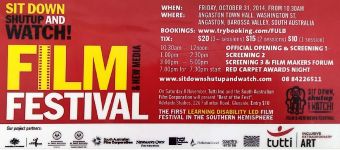 "Tutti Arts - Sit Down Shut Up & Watch - Promotional Card 2014" Tutti Arts - 'Sit Down Shut Up & Watch' 2014 Promotional Card
-
 "The Arts and Disability 2017" This booklet/brochure provides images, descriptions of the work, and contact details and contact organisations for key organisations in South Australia including: Access2Arts; Company AT; Mindshare; No Strings Attached Theatre of Disability; Restless Dance Theatre; Sit Down, Shut Up and Watch Film and New Media Festival; Sisters of Invention, Tutti Arts; The Jame, The Mix, The Gig.
-
"Arts Access Australia appoints Emma Bennison (2012) and Megan Shand (2017) as CEO" Prior CEO Kate Larsen statesin 'Disability Leadership: If You're Gonna Talk the Talk .... ABC: Ramp Up, 30 March 2012' - "Now, I love my job. I'm good at it. I think that I've been useful here. But on the same day I accepted the position last February I also did something else. I gave notice of my resignation, and undertook to hand over the organisation by the end of 2012. The reason? Because I believe that Arts Access Australia should be led by a person with disability."
-
"International Year of the Disabled Person (IYDP)" In 1976, the General Assembly proclaimed 1981 would be the Year of the Disabled Person. The 1981 International Year of the Disabled Person inspired an increase in awareness and disability arts. While UN theme was “full participation and equality” the theme in Australia was “Break down the Barriers”, raising the prole and issues of people with disabilities. The international year of the disabled persons was a catalyst for connecting Australian disability activists to each other and the international disability rights movement (Royal Commission, 2021, p. 6). Australia saw an increase in disability-themed theatre from 1981 to 1984; however, these performances were largely staged with non-disabled casts. Records of these productions can be found on the AusStage database.
-
“The Commonwealth Disability Services Act of 1986 replace the Handicapped Persons Assistance Act of 1974” In 1983, The Hawke Labour Government evaluated the initiatives created under the Handicapped Persons Assistance Act of 1974. The HPAA was replaced in 1986 by the Commonwealth Disability Services Act of 1986. Among other changes, this Act represents the shift in nomenclature from 'handicap' to ‘disability’.
-
“Crossroad Arts (Queensland) founded in 1996” Crossroad Arts (Queensland) was founded in 1996 by Steve Mayer-Miller. "Crossroad Arts collaboratively develops opportunities for people who experience a disability, to access and participate in the arts".
-
“Access Arts Achievement Award inaugurated in 2014” Access Arts announced a $10,000 Achievement Award in 2013 and first awarded the grant in 2014 to actor Doug Robins. Other recipients since then have included writers, musicians, visual artists, theatre makers, and multi-disciplinary artists. The funding goes to a Queensland artist with disability to “create, develop, present, produce, exhibit and/or tour their work.” Access Arts describe it as “a game-changing opportunity for Queensland artists, arts workers and producers to extend the life of an existing work or create a new one!”
-
“Protesters gather in Lismore (NSW) to oppose proposed cuts to services” In 2004, 300 disabled persons, along with their relatives and carers, gathered in Lismore to protest proposed cuts to adult, training, learning, and support programs, among other services. These were a part of a series of demonstrations against the state government that included hundreds of demonstrators in Newcastle and resulted in the state government reversing its position on modifications to the Post-Schools Options Disability Program.
-
“The National Disability Insurance Scheme (NDIS) is launched” Following the spike in interest in the mid to late 2000s, significant steps were made towards the development of the National Disability Insurance Scheme (NDIS). It came about as the result of discussions about alternatives of disability support arrangements from 2007 to 2011. This included National Disability Strategy 2010–2020. A trial phrase of the NDIS was launched in 2013, and the scheme was rolled out across the country from July 2016. The 2022 change of government, which saw the Labor party voted in for the first time in nine years, reflected voter concern for climate change and social policies. The new prime minister Anthony Albanese ordered an independent review of the NDIS. The NDIS Review report was published in 2023 and had a number of recommendations, including affording funding based on functional impairment rather than diagnosis, increasing support for children, a requirement that all providers be registered, and state governments providing supports through other services for people who do not meet NDIS criteria.
-
"Bree Hadley (2015) Participation, politics and provocations: People with disabilities as non-conciliatory audiences. Participations: journal of audience and reception studies, 12(1), pp. 154-174.” "Disability has always had a prominent place on the theatrical stage. Throughout the C19th, C20th and C21st to date, disabled characters have been used to signify corruption, innocence or suffering, and, of course, as salutary examples of how to overcome such suffering. In the past three decades, the work of disability scholars, activists and artists has also provided opportunities for people with disabilities to produce their own plays, performances or installations challenging these stereotypes. Interestingly, though both the body of literature on theatre makers with disabilities and the body of literature on theatre audiences has grown apace over the past decade, there is still surprisingly little written on people with disabilities as theatre audiences. In this article, I draw on observations made during five years of practical, empirical and theoretical research into disability theatre to discuss how people with disabilities work as a distinctive sub-group of spectators, with distinctive spectatorial processes, modalities and preferences, within contemporary theatre audiences. I begin with the factors that make attending theatre difficult for people with disabilities. I note that people with disabilities respond to the challenges they face in attempting to become active audiences of contemporary theatre in three common ways. I then unpack what these spectatorial modalities teach us about people with disabilities as audiences, other marginalised groups as audiences, as well as about audiences, audiencing and the part audiences play in theatre practice more generally."
-
"Bree Hadley (2017) Disability, Sustainability, Austerity: The Bolshy Divas Arts-Based Protests Against Policy Paradoxes. Centre for Sustainable Practice in the Arts Journal 18 Spring. http://www.sustainablepractice.org." "In this short article, I want consider some of the ways theatrical artists, activists and advocates in Australia are tackling the paradoxical relationship between sustainability and austerity discourses, and, as a result, some changes this may be starting to produce in disabled people’s aesthetic prerogatives. For the last 30 years, artists, activists and scholars in Australia and beyond have avoided casting disability in terms of trauma, crisis, catastrophe and disaster. Accounts of the way disability theatre challenges stereotypes , as well as analysis of disability signifiers in screen, stage, and social performance , have expressed concern about deploying disability as a metaphor for disaster, or defining disabled people as monstrous, tragic, stoic, or inspirational, the way the medical model of disability traditionally defines us. Instead, modern disabled artists and the scholars who analyse them have advocated for work that deploys live art, performance art, and performative intervention in public space to challenge stereotypes, oppressive institutional systems, and other factors the social model of disability sees as the cause of disability oppression .In the last few years, though, there has been an increase in work that does associate disability with trauma, tragedy and disaster, in what seems to be a response to austerity, accountability and economic sustainability agendas that call for cuts to disability services spending to make our societies more sustainable going forward."
-
"Amanda Cachia (2022) Networks of Care: Collectivity as Dialogic Creative Access, in Amanda Cachia ed. Curating Access: Disability Art Activism and Creative Accommodation. London: Routledge, 219-230" Reads, in part "The collectives that have formed in recent years and that will be the subject of this chapter include the Feminist Health Care Research Group (FHCRG), the Sickness Affnity Group (SAG), and Power Makes Us Sick (PMS). Each of these groups attempts to be intersectional in their approach, focusing on feminist and crip revisions to health care. Feminist and crip unite in the groups as the participants all identify as both women and as disabled. In shared spaces, which can be found in physical spaces, such as an art gallery or an artist’s home, or online through Zoom, artists can offer mutual understanding of their experiences with chronic illness, disability, the medical industrial complex, and simply be a shoulder to lean on in times of anxiety, anger, and sadness. The collectives also offer an opportunity for the artists to lift each other up, creating an environment of respect, dignity, and self-worth, becoming a strong circle of empowerment, affrmation, and allyship. The proliferation of these support groups shows a general shift in social norms, where the medical feld no longer holds the only authoritative voice on health. This phenomenon also indicates how nonmedical health based groups are flling a need and making up for a lack in social support networks elsewhere, particularly within sanctioned medical arenas."
-
"Ruth Rentschler, Boram Lee, Ayse Collins, Jung Yoon (2023) ‘I am a professional dancer’: A case study of performing artists with disability. In Wyszomirski, M. J. & Chang, W. (Eds.), Building professionalism in the creative sector. Oxon: Routledge, 227-246" "The demand for professional recognition for artists with disability is growing. There is little research, however, on the ways in which disability arts are associated with professionalism. This study examines professionalization in disability arts by comparing it with the concept of professionalization in the arts generally. It identifies three components of professionalization in disability arts by means of a case study of an inclusive arts organization. This qualitative study entails 17 semi-structured interviews with artists, staff members, and other stakeholders both with and without disabilities."
-
"Una Rey (2022) Art and sensoria: Whose disability? ArtLink, 42(2), pp.8–11." "SENSORIA: Access & Agency is ArtLink’s effort to affect this swell by providing a platform for divergent perspectives and nuanced articulations of being an artist. Whatever the prevailing conditions. It also invites a discussion within contemporary art discourse that is not driven by fear (of getting it wrong, of ‘the other’, of adding injury to trauma). Art is our place of intersectionality: if you’re reading ArtLink, you’re already on the margins, and quite possibly on the spectrum."
- Bolshy Divas
- Emiko Artemis
- Kate Larsen