-
"Bree Hadley (2022) Disability and the Arts, Creative, and Cultural Industries in Australia. Australian Academy of Humanities"
"This week saw the release of Ensuring Occupations are Responsive to People with Disabilities, a landmark report by the Australian Council of Learned Academies (ACOLA) commissioned by the Australian Government Department of Social Services. As part of the Academy of Humanities’ support for the project, Professor Bree Hadley provided a study of disability in the arts, creative, and cultural industries for the project, and Professor Gerard Goggin was a member of the Expert Reference Group. In this week’s Five-Minute Friday Read, they explain why disability training needs fundamental reform now."
-
”Racheal Missingham, Bree Hadley (2022) Oppression and allyship in Australia's Deaf Arts. Australasian Drama Studies, 80, pp. 304-332.”
"In this article, we investigate the history of Deaf theatre in Australia, through the lens of oppression and allyship. Through a review of the to date limited academic, industry, and media literature, in conjunction with survey and interview research with Deaf theatre practitioners, this research sheds light on Deaf theatre makers’ perceptions of the ways in which ally support can operate to create both social benefits and barriers, and how this has impacted on the non-linear development and recent decline in Deaf theatre companies in Australia. It finds that, in developing a framework to scaffold stronger allyship relationships with d/Deaf and hard of hearing artists, it is critical to consider the accessibility and cultural requirements not just in relation to theatre methodologies, but in relation to arts management practices, which support continuing company production, too."
-
”Hadley, Bree, Paterson, Eddie, & Little, Madeleine (2022) Quick Trust and Slow Time: Relational Innovations in Disability Performing Arts Practice. International Journal of Disability and Social Justice, 2(1), pp. 74-94.”
"Despite a range of policies, plans, protocols and funding programmes to support disabled artists and collaborations between mainstream producers and disabled artists, the statistics – at least in our context in Australia – suggest most disability art still occurs outside and alongside an industry that struggles to include these artists. In this article, we draw upon findings from a series of workshops with disabled artists around Australia, conducted as part of the ARC funded Disability in the Performing Arts in Australia: Beyond The Social Model project – known colloquially to its collaborators and participants as ‘The Last Avant Garde’ project (https://lastavantgarde.com.au) – to propose a new approach. We find that while provision of logistical access (ramps, hearing loops, interpreters) and ideological access (stories, characters, discourse and language) is critical, so is methodological access, which embodies disability culture in training, rehearsal and production processes. Disabled artists use crip culture, along with relational space and time to negotiate what happens in disability arts and culture production practices and work through desire, fear, vulnerability and reciprocity to rapidly establish trusting collaborations."
-
“Angharad Butler-Rees, Bree Hadley(2023) Exploring the Role of the Disabled Body as a Vehicle and Art Form within Anti-Austerity Protest. In Zebracki, Martin & McNeill, Z. Zane (Eds.) Politics as Public Art: The Aesthetics of Political Organizing and Social Movements. Routledge, Abingdon, Oxon, pp. 116-132.”
"The impact of neoliberal austerity policy is being felt by people with disabilities across the globe. This chapter attends to disability protest in response to austerity across two contexts—the United Kingdom and Australia. It examines how people with disabilities are choreographing their protest, the strategies they are using, and the outcomes they are seeking."
-
”Bree Hadley, Janice Rieger, Sarah Barron, Sarah Boulton, Catherine Parker (2023) Codesigning Access: A New Approach to Cultures of Inclusion in Museums and Galleries. In Cachia, Amanda (Ed.) Curating Access: Disability Art Activism and Creative Accommodation. Routledge, Abingdon, Oxon, pp. 183-195.”
"In museums and galleries, access is often designed and implemented by staff and informed by regulations and guidelines. Codesign approaches have the potential to shift this understanding away from designing access “for” visitors and toward access as a creative process developed “with” visitors. This chapter focuses on the exhibition and practice-led research project Vis-ability: Artworks from the QUT Art Collection, which was presented at the Queensland University of Technology (QUT) Art Museum in Australia in 2019. Vis-ability represented the culmination of five years of international research into access in museums and galleries for visitors who are blind or have low vision."
-
"Bree Hadley, Janice Rieger, Eddie Paterson (2024) Reinhabiting, Reimagining, and Recreating Ableist Spaces: Embodied Criticality In Art. In Ellis, Katie, Kent, Mike, & Cousins, Kim (Eds.) The Routledge International Handbook of Critical Disability Studies. Routledge, pp. 48-58."
"In this chapter we bring critical disability studies into dialogue with disability artworks that resituate critiques of inaccessibility and exclusion as complicated encounters with space, lived experience and embodiment. Drawing on Irit Rogoff’s (2003, 2006) notions of embodied criticality, and the pioneering work of performance studies scholar Petra Kuppers (2003, 2014), we argue for an embodied, embedded and creative form of critical disability studies – enacted through art. We examine two recent performance and installation works in hotels: Welcome Inn (2019) by British artist Christopher Samuel, and Intimate Space (2017) by Australian performance company Restless Dance Theatre."
-
"Bree Hadley, Eddie Paterson, Madeleine Little, Kath Duncan (2024) How Disability Performance Travels in Australia: The Reality Under the Rhetoric. In Czymoch, Christiane, Maguire Rossier, Kate, & Schmidt, Yvonne (Eds.) How Does Disability Performance Travel?: Access, Art, and Internationalization. Routledge, Abingdon, Oxon, pp. 62-76.”
"The last three decades has witnessed the development of a distinct narrative about how disability performance has become a much celebrated component of the Australian theatre landscape. A central aspect of this narrative is the critical importance of festivals, events, and other industry initiatives that allow disabled performers to travel - both conceptually and corporeally - to meet and be mentored by other artists, and to present their work to new and more mainstream audiences, in new spaces and places, around the country, and around the world. In this chapter, we draw on historical data, collected as part of an AusStage ARC LIEF project designed to database information about disability drama, theatre, performance, and dance over the past 100 years, as well as the Last Avant Garde ARC Linkage project on disability performance in Australia, to unpack areas where the reality seems to challenge some of the dominant rhetoric."
-
”Bree Hadley, Janice Rieger, Katie Ellis, Eddie Paterson (2024) Cultural safety as a foundation for allyship in disability arts. Disability & Society, 39(1), pp. 213-233.”
"In this article, we argue that cultural safety, respect, and trust is a precursor to good allyship in the creative industries. We outline factors that influence feelings of safety or non-safety for disabled arts and media makers, and the way the legacy of the medical model makes it difficult for many arts and media workers to appreciate and enact enablers of safety as part of an allyship relationship."
-
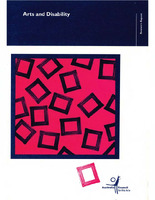 "Juliet London and Des Walsh (1995) Arts & Disability: Report Australia Council: Surry Hills."
 Juliet London and Des Walsh - Arts & Disability, Australia Council 1995 - Reads, in part "The Australian Bureau of Statistics estimates that 18 per cent of the Australian population has a disability. There is a basic lack of data on participation in the arts by artists with a disability. No figures were available on the number of people with disabilities applying for grants from the Australia Council or from State or Territory arts agencies. The current dearth of statistical information needs to be overcome by systematic and sustained research."
-
"Creative Australia (2024) releases 'Equity: Arts and Disability Associated Plan"
Reads, in part "The Australia Council for the Arts have released their critical new report Towards Equity: A research overview of diversity in Australia’s arts and cultural sector. This overview gathers published and unpublished data and research on representation within the arts and cultural sector in Australia."
-
"Queensland Government releases Arts & Disability Plan 2024-2026"
Reads, in part "The Queensland Government acknowledges the rights of people with disability to participate equally in the state’s cultural life and to have the opportunity to develop and use their creative, artistic and intellectual potential, as recognised in the United Nations Convention on the Rights of Persons with Disability."
-
"Australia Council for the Arts (2022) Australia Council releases Towards Equity: a research overview of diversity in Australian arts."
Reads, in part "The Australia Council for the Arts have released their critical new report Towards Equity: A research overview of diversity in Australia’s arts and cultural sector. This overview gathers published and unpublished data and research on representation within the arts and cultural sector in Australia."
-
“Deaf film ‘A Silent Agreement’ is released in 2017”
The Deaf film ‘A Silent Agreement’ was released in 2017 (written and directed by Davo Hardy). This romantic drama features a profoundly Deaf human rights activist and his filmmaker boyfriend with a speech impediment. It is said to be the first Australian film to feature Auslan as the main dialogue. Some scenes are entirely in Auslan. Screen Australia calls it the “first Australian film to feature Auslan.”
-
“Production company A2K Media founded in 2007, as a 'a Disabled-led production company, creating connections that entertain, educate, and empower'”
A2K Media is “a Disabled-led production company, creating connections that entertain, educate, and empower.” In 2024, A2K launched their Disability Justice Lens course, which teaches screen professionals how to bring disabled people onto their productions and make their workplaces more accessible and empowering.
-
“Bus Stop Films begins operation in 2009”
Bus Stop Films began operations in 2009. In their own words, they “educate, create and advocate.” Their primary focus is teaching filmmaking to disabled adults, but they also offer workshops to others of marginalised identities. Bus Stop “makes films with, for and about people from diverse backgrounds and abilities.” Their website lists support workers in every Australian state and territory.
-
“2023 Screen industry report ‘Disability and Screen Work in Australia’ finds disabled people fulfil a range of roles in the screen industry, despite facing prejudice and exclusion, and should be treated as experts of their access requirements”
‘Disability and Screen Work in Australia: Report for Industry’ (2023) was compiled by researchers Radha O’Meara, Laura Dunstan, Anna Debinski and Catherine Ryan. The study was supported by Melbourne Disability Institute and A2K Media. The authors summarise that disabled people fulfil a range of roles in the screen industry, despite facing prejudice and exclusion, and should be treated as experts of their access requirements. They find that “Disabled people experience a more precarious, lower paid, and less powerful position in the screen industry than their non-disabled counterparts.” O’Meara and her colleagues call for widespread change in the industry to expand access.
-
“The South Australian Film Corporation announces their disability screen strategy”
The South Australian Film Corporation launched their disability screen strategy. First, their Diversity and Inclusion Strategy 2022-2032, which they say “breaks new ground nationally,” defines quantifiable 10-year targets. In addition, the SAFC has developed a Disability Equality Plan, Targeted Diversity Attachments, the FULL TILT Short Documentary Initiative, and Film Lab: New Voices, a feature film development program presented by SAFC with Adelaide Film Festival and Mercury CX.
-
“Screen Australia launches an access coordinator training program”
Screen Australia launched an access coordinator training program in 2023. “The Access Coordinator role is intended for people from the Deaf/Disabled and/or Neurodivergent (DDN) communities who are committed to improving disability representation and removing barriers to inclusion.” Screen Australia partnered with the following organisations for the initiative: the New Zealand Film Commission, Screen Queensland, Screen Tasmania, Screen Territory, Screenwest, VicScreen, the South Australian Film Corporation, Screen ACT, Screen NSW, and the Australian Film Television Radio School.
-
“Screen producer, editor, and accessibility consultant Stephanie Dower is interviewed for Screen Queensland On Air, in an episode called How They See Us: Disability in the Screen Industry”
Stephanie Dower was interviewed in 2020 for Screen Queensland On Air, in an episode called How They See Us: Disability in the Screen Industry. Dower is an editor, producer, and writer for screen. She has also worked with Get Skilled Access and as an accessibility consultant for Queenslanders with Disability Network.
-
“Disabled actor and writer Heather Rose stars in ‘Dance Me to My Song’ (1998)”
The 1998 film ‘Dance Me to My Song’ stars Heather Rose, who also co-wrote the film. It is about a woman with cerebral palsy, whose carer resents the job. The dramatic tension rises when the two women both take an interest in the same man. The Rolf de Heer-directed film is significant for casting a disabled actor at a time when authentic disability representation was rare, not to mention Rose’s contribution to the screenplay. ‘Dance Me to My Song’ was selected to feature in the Cannes International Film Festival in May 1998. The documentary ‘Heather Rose Goes to Cannes’ (1998, Christopher Corin) follows Rose’s journey from Adelaide to Cannes.
-
“The Australian Government announced a National Autism Strategy in 2022”
In 2022, a National Autism Strategy was announced by the Australian Government. The Department of Social Services note that the strategy developed out of a “comprehensive co-design process.” Its objectives relate to social inclusion; economic inclusion; diagnosis, services and supports; and health and mental health. The strategy puts forth a “vision for a safe and inclusive society for all Autistic people. One where we support and empower Autistic people to thrive, in all aspects of life.”
-
“Australia Council start development of Code of Conduct for Access in The Arts”
Australia Council started development of Code of Conduct for Access in The Arts. Consultation took place in 2021-2022.
-
“The Australian Government launches a new national cultural policy, Revive: a place for every story, a story for every place”
The Australian Government launched a new national cultural policy, Revive: a place for every story, a story for every place. Revive comprises 5 pillars: First Nations First, A Place for Every Story, Centrality of the Artist, Strong Cultural Infrastructure, and Engaging the Audience. The policy allocates $5 million for an Arts and Disability Associated Plan, under Australia’s Disability Strategy 2021–31 “to enable people with disability to access and participate fully in the cultural and creative life of Australia.” This replaces the National Arts and Disability Strategy.
-
“Auslan features intermittently on Australian television throughout the 1990s, 2000s, and 2010s”
Auslan appeared intermittently on Australian television throughout the 1990s, 2000s, and 2010s. Ana Maria Belo has curated a video compilation of scenes featuring Auslan. Belo calls it “a very brief history lesson on Deaf Actors on Australian Television before Social Media.” As she explains, “this is not a complete list of performances, but a nod to the actors who blazed a mighty trail for those of us who attempt to follow.”
-
“Off The List Records (VIC) established in 2020”
Off The List Records (VIC) was established in 2020. Their Facebook page describes them as “an access-friendly and disability-led record label, working within the DIY, experimental and indie music scenes in and around Naarm.”